Way Cool Plumbing & Air
← Blog·Plumbing·

Can Your Phoenix House Actually Handle a Tankless Water Heater?

Deciding you want tankless is the easy part. Whether your house can support one comes down to gas line capacity, venting, electrical, and where the thing is going to live.

Can Your Phoenix House Actually Handle a Tankless Water Heater?

QUICK ANSWER

Not every home can accept a tankless water heater without modifications. The main factors are gas line capacity (tankless units demand far more BTU on demand than a tank), venting requirements, electrical availability, installation location and clearances, and household hot-water demand. Phoenix hard water also makes descaling access part of the install plan rather than an afterthought.

We're not going to relitigate tankless versus tank here — we already did that in tankless vs tank water heater in Phoenix. Say you've read it, you want tankless, and you've made peace with the tradeoffs.

The next question is the one that actually determines your quote: can your house take one as it sits, or does it need work first? Here's what a plumber is looking at when they walk your garage.

Gas line capacity is the usual dealbreaker

This is the first thing checked and the most common reason a straightforward tankless swap turns into a bigger project.

A tank water heater heats slowly and steadily — it has a whole tank of stored water and all day to bring it up to temperature. A tankless unit has to heat water instantly as it flows through, which means it demands substantially more gas at once. That demand often exceeds what the existing gas line to the water heater was sized to deliver.

The evaluation isn't just the line to the appliance, either. It's the meter capacity and the whole distribution — your furnace, range, dryer, and pool heater are all drawing from the same supply. Upsizing the line is routine work, but you want to know about it before you're committed, not after.

Venting is different, and it isn't optional

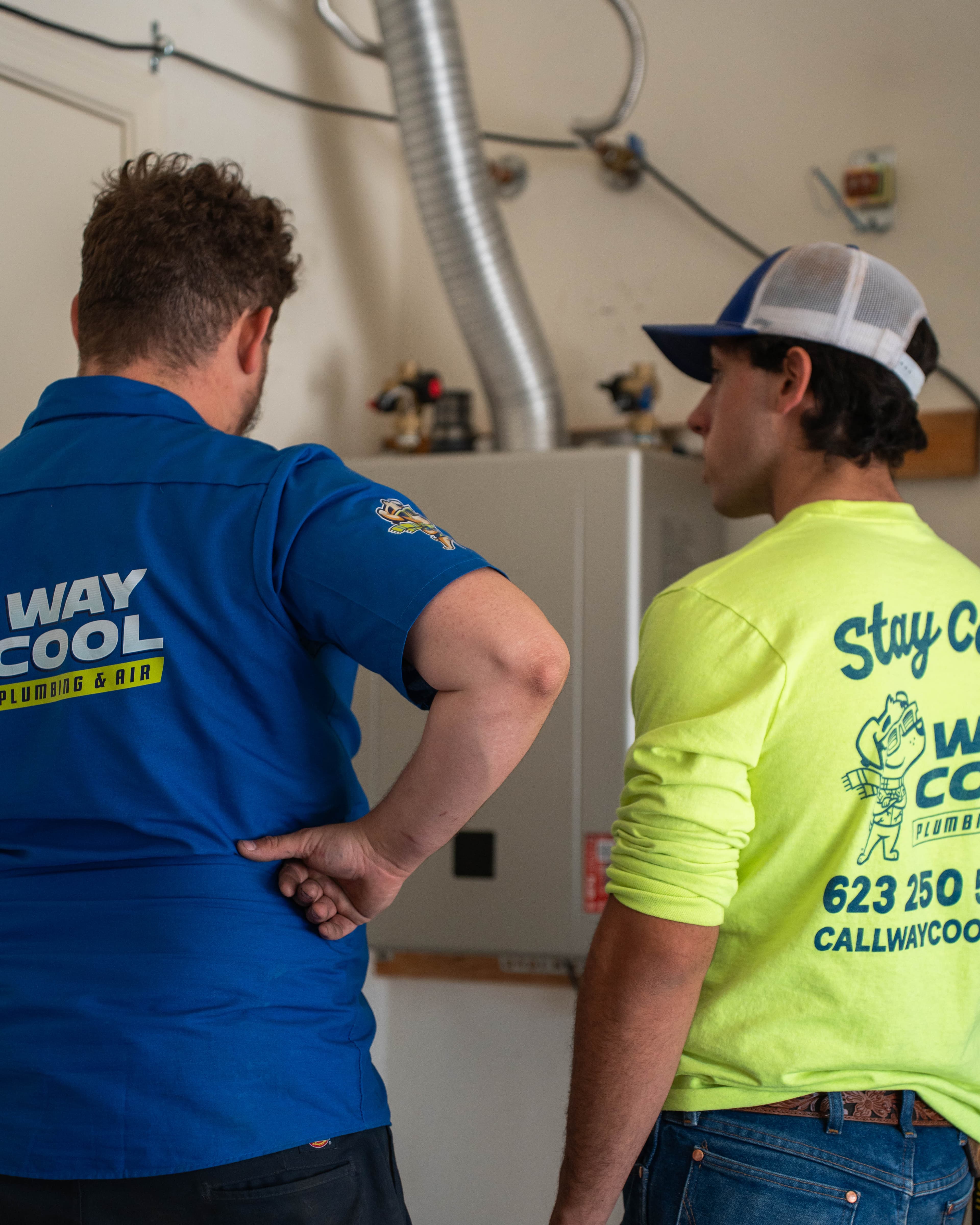
Tankless units don't vent the way a conventional atmospheric tank does. Most modern condensing units require sealed, dedicated venting run in specific materials with specific termination clearances.

That's usually workable, but the location matters a lot. A water heater sitting against an exterior garage wall is an easy vent run. One tucked into an interior closet in the middle of the house is a longer conversation. Whether existing venting can be reused, abandoned, or has to be replaced outright is part of the site evaluation, not something to assume.

Yes, a gas tankless still needs electricity

This one surprises people. Gas tankless units have electronic ignition, controls, and a circulation fan — they need power. If your water heater location doesn't have a receptacle nearby, that's an electrical addition.

It also means a gas tankless will not produce hot water during a power outage, which a standard atmospheric tank generally will. For most Phoenix homes that's a non-issue. It's worth knowing anyway.

Sizing is about flow rate and temperature rise

"Endless hot water" is true of a properly sized unit and misleading about an undersized one. Every tankless has a maximum flow rate at a given temperature rise — how many gallons per minute it can raise from incoming temperature to your setpoint.

The good news for us is that Phoenix incoming water is warm compared to most of the country, so the required temperature rise is smaller and units perform closer to their rated capacity. The catch is demand: two showers running while the dishwasher fills is a different sizing problem than one bathroom. Sizing is done against how your household actually uses hot water, not the square footage of the house.

Phoenix hard water changes the maintenance plan

Our water hardness runs high, and buying a nicer water heater doesn't change the chemistry. Mineral scale accumulates inside a tankless heat exchanger and reduces performance over time.

Two practical consequences. First, isolation valves should go on at install so the unit can be descaled without cutting pipe later — a small thing at installation, an annoying thing to retrofit. Second, periodic flushing becomes part of owning the equipment. If you already have or are considering a softener, that conversation belongs in the same visit. More on our water in why Phoenix has hard water.

Tankless does not mean maintenance-less. That misunderstanding gets expensive.

Frequently Asked Questions

Can every home switch to tankless?

Not automatically. Gas line and meter capacity, venting requirements, electrical availability, installation location and clearances, and household hot-water demand all need to be evaluated first. Many homes can — some need modifications to get there.

Why does a tankless water heater need a bigger gas line?

A tank heats water gradually using stored capacity. A tankless unit heats water instantly as it flows, which requires substantially more gas at once. That instantaneous demand often exceeds what the existing line and meter were sized to deliver.

Does a gas tankless water heater need electricity?

Yes. Gas tankless units use electronic ignition, controls, and a fan, so they require a power connection — and they won't produce hot water during an outage, unlike a standard atmospheric tank.

Does a tankless water heater provide unlimited hot water?

A properly sized system can provide continuous hot water, but every unit still has maximum flow and heating capacities. Run more simultaneous fixtures than the unit is rated for and you'll notice. Sizing against your actual household demand is what makes the difference.

Do tankless water heaters need maintenance in Arizona?

Yes. Hard-water scale makes routine flushing important. Isolation valves installed at the time of the install make that descaling straightforward instead of a plumbing job every time.

Thinking about going tankless? We'll look at your gas capacity, venting, electrical, location, and how your household actually uses hot water — then tell you honestly whether it makes sense for your house. Schedule with Way Cool Plumbing & Air or call (623) 250-6492. Stay Cool with Way Cool.

Got more questionsOr Want a Quote?

Schedule online or call. $89 service call, waived with any approved repair.

Call (623) 250-6492
CALL